

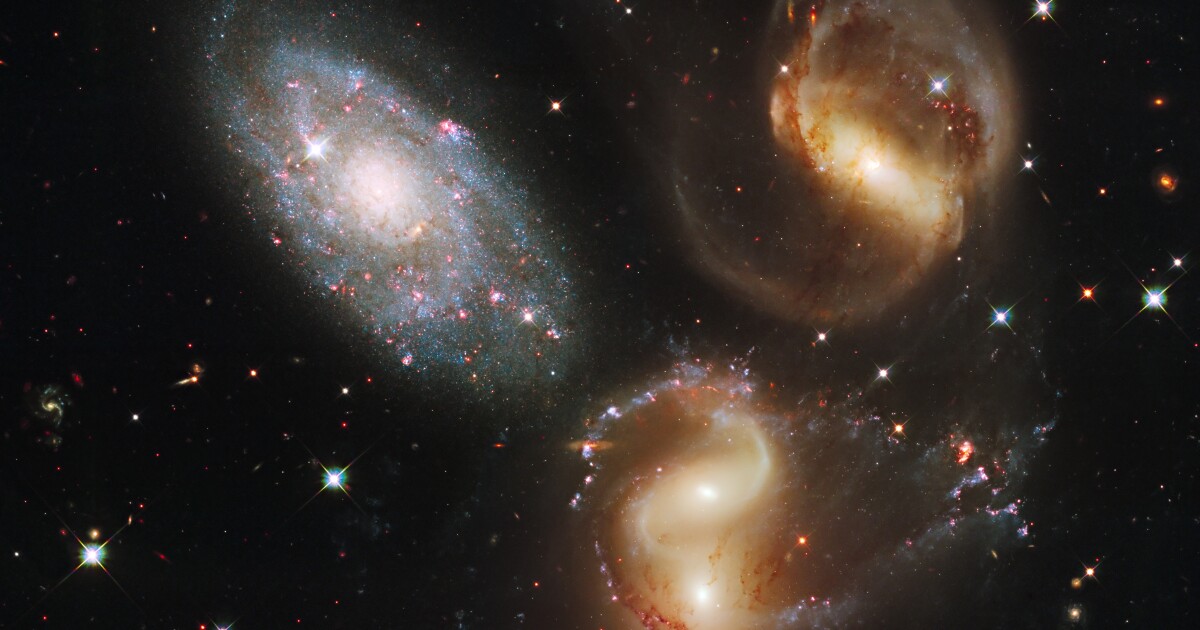
Astronomers have clocked a cosmic collision at 3.2 million km/h (2 million mph). A new instrument has spotted a galaxy crashing through a group of others at incredible speeds, creating a shock wave that’s changing the region completely.
Stephan’s Quintet is a structure made up of five galaxies in close proximity to each other in the sky, which was first discovered by French astronomer Édouard Stephan in 1877. But it’s not quite as peaceful as its name and images suggest – this is the scene of a slow-motion smash.
Stephan’s Quintet is the cosmic equivalent of glass and metal scattered across a road after a car crash. The four galaxies involved have already hit each other and sent some of their material flying into a debris field, and are slowly skidding back together where they’ll probably merge into one giant galaxy eventually.
“Slowly” is, of course, a relative term: these galaxies are traveling at millions of miles per hour, but because it’s happening on the cosmic scale it will still take a few million years before they merge. In our tiny human experience, we basically see a freeze frame of the whole event.
On a side note, you might have noticed it’s called a quintet but only four galaxies are involved in the collision. That’s not a mistake – the lighter galaxy at the upper-left of the image is actually more than 200 million light-years closer to Earth than the rest of the group. It’s just photobombing the scene, but obviously Stephan had no way of knowing that in the 19th century.
Anyway, a powerful new instrument has now revealed more details about this collision. This moment in time isn’t the calm eye of the storm that it may appear – instead, one of these galaxies is still actively plowing into the others.
The discovery was made with WEAVE, a new spectrograph added onto the William Herschel Telescope in Spain, along with data from LOFAR, James Webb and the Very Large Array. An international team of over 60 astronomers measured how the system was being shocked by the impact.
The current culprit is NGC 7318b, which can be seen as the upper bright spot of the two in the center of the image. This galaxy is charging into the group from behind, meaning it’s basically charging straight towards us from our viewpoint here on Earth.
The team calculated that NGC 7318b is traveling at a ridiculous speed of over 3.2 million km/h (2 million mph), producing a powerful shock wave in the neighboring galaxies. This shock front seems to have a dual nature – fast and strong as it moves through cold gas, and weaker through regions of hot gas. These produce different types of signals that can be picked up by multiple observatories.
“As the shock moves through pockets of cold gas, it travels at hypersonic speeds – several times the speed of sound in the intergalactic medium of Stephan’s Quintet – powerful enough to rip apart electrons from atoms, leaving behind a glowing trail of charged gas, as seen with WEAVE,” said Dr. Marina Arnaudova, lead researcher on the study. “Instead of causing significant disruption, the weak shock compresses the hot gas, resulting in radio waves that are picked up by radio telescopes like the Low Frequency Array (LOFAR).”
The team hopes that this kind of work will help astronomers better understand the dynamics of galaxies, how they formed and how they evolve over time. Intriguingly, this is the very first experiment that WEAVE has conducted, so it should have a long productive life ahead of it.
The research was published in the journal Monthly Notices of the Royal Astronomical Society.
Source: Royal Astronomical Society
