

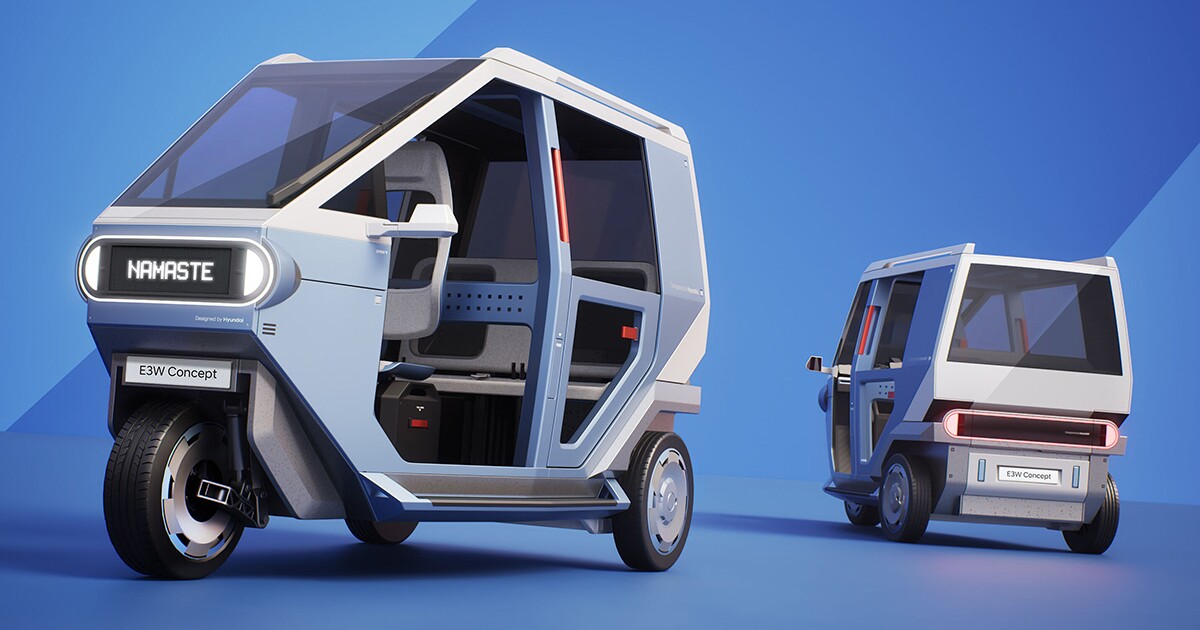
One of the most compelling exhibits at India’s expansive Bharat Mobility Expo for automobiles was also among the least covered earlier this month. Hyundai teamed up with TVS – the third largest two-wheeler manufacturer on the planet – to showcase a couple of cool electric micro mobility concept vehicles for India’s congested roads.
The E4W car and the E3W rickshaw share several cues in their minimalist styling, and both concepts are designed to be practical, as well as easy to manufacture. The 3-wheeler is especially exciting because it looks like it could vastly improve daily commutes for millions of people in India who have no choice but to settle for rickety, uncomfortable rickshaws.
SangYup Lee, Head of Hyundai and Genesis Global Design, explained that the marque’s customer-centric focus drove it to “explore designing micro-mobility solutions tailored to India’s unique environment, reimagining the iconic three-wheeler to enhance mobility experiences through thoughtful design.”
Both vehicles feature simplistic but distinctive designs comprised of obvious shapes and bold lines, and they suit the purpose of last-mile mobility. There are also several clever details that would make these compelling for urban commuters.
Hyundai Motor
Hyundai has used recycled plastics and flat panels for both models’ exteriors. These considerations would make them easy to produce, and less expensive for owners to replace parts.
The central side pillars incorporate grab handles to help you get into the vehicle, and fold-out side steps for climbing up to access luggage on the roof. You’ll also notice angled windshields that should offer good visibility, as well as flat floors and long wheelbases for more legroom.
There are also narrow but otherwise proportionally large wheels that should make rides on bad roads a bit more comfortable. Hyundai says it’s also designed both models with “enhanced collision protection” in mind.
And now for some elements specific to each vehicle that stood out to me:
E4W
From the bodywork and cutout-style doors, it’s clear that this little car is still an early concept. Once in the driver’s seat, you’ll spot a steering wheel with touch controls built in, and a slim screen for a minimalist dashboard.
The cabin looks really roomy, with the car’s battery stowed away under the front seats. In the back, you’ve got bench-style seating, and a pegboard facing the rear passengers. The latter lets you mount accessories like an electric sanitizer, a fan, and an umbrella holder. It also houses USB ports to charge your gadgets.
E3W
Hyundai seems particularly keen on seeing this one through soonish. The team behind this took input from three-wheeler users on board, and considered ways to make it easier for drivers who operate these vehicles for upwards of 10 hours a day to live with.
To that end, it’s said to be 200 mm longer than a typical rickshaw, and its roof height is about 35 mm more too. That should make entering and exiting the vehicle less of a bother. The front seat position is set for maximum driver comfort, and to negate the need to sit hunched over the handlebars.
There are some basic driver comforts built in as well, like holders for water bottles and smartphones, USB charging ports, and storage spaces below the seat and near the dash. Hyundai says it’s structurally engineered the E3W to reduce rattling and passenger discomfort on bad roads.
And unlike traditional rickshaws, Lee pointed out to Acko Drive how it’s “so important to have accessibility in the last mile of the mobility.” That’s why the E3W gets a foldable bench seat in the rear, along with a back door and ramp that enables a wheelchair to roll into the cabin comfortably within 20 seconds.
“Collaborating with TVS Motor, we aim to locally produce the three-wheeler while exploring global opportunities for the four-wheeler, blending intuitive functionality with the spirit of a rapidly innovating India,” Lee said.
Powertrain and battery configurations haven’t yet been revealed for either vehicle. Autocar India noted that the E3W’s pricing is expected to be competitive with current e-rickshaws. For reference, TVS’ first foray into 3-wheelers, the recently launched King EV Max, costs INR295,000 (US$3,410), with a certified range of 111 miles (179 km) and a top speed of 37 mph (60 km/h).

TVS Motor
Hopefully, Hyundai will figure out ways to produce the E4W soon too – it’s awfully cute and could make for a great ride-sharing vehicle in congested cities. These ambitious concepts are the sort of thing I’d like to see more of at auto shows in the future.
Source: Hyundai
